
阿部 詩
パーク24
Uta Abe (PARK24 CO., LTD.)
I want to be a strong athlete who can live up to people’s expectations and repay their support
Treasuring each year as I aim to become the best in the world again
December 23, 2025
![Judoka [Uta Abe]](/ito-sports-project/assets/img/interview/015/pct_mv.webp)
Interview: Masafumi Mikawa / Photos: Maki Kato
What matters about conditioning is being thorough about the basics
- ITO: What do you see as the appeal of judo?
-
Abe: Judo isn’t something you can do alone. It’s a sport that requires an opponent. That’s why, even before getting stronger, you can learn proper courtesy and cultivate gratitude and respect toward your opponent. Of course, the sense of achievement you feel when you throw your opponent in a match is great. It’s a moment when you feel all the hard practice you did up to that point paid off.
- ITO: How much training and practice do you do daily?
-
Abe: When I don’t have a competition coming up, I practice six days a week. I do training for a little under two hours and practice for two to two and a half hours, with rest periods for sleep and things like that in between. I also run sometimes for mental toughness. When practice ends, I attend to my body, have dinner, and then go to bed. I repeat that routine day in and day out.
- ITO: For the year, what schedule do you follow for practice and competitions?
-
Abe: Since judo doesn’t have an off-season, I schedule matches throughout the year. Among these are competitions that involve national team selection. I compete in three or four tournaments a year, usually spaced so that there’s one or two in the early part of the year, from February to March, one or two in the middle of the year, from June to August, and maybe another toward the end of the year, from October to December.
Daily practice is essential to winning matches. In addition, we’re expected to consistently deliver high-level performance, so conditioning is crucial. I think what’s important is to be rigorous with the basics, meaning sleep, meals, receiving care, and so on.
-
I make sure to get enough sleep. I normally get seven to eight hours at night, plus another hour and a half during the day between practice sessions. For meals, I don’t need to lose much weight, so I don’t manage it very strictly. I think I’m getting sufficient nutrition from my regular meals.
- ITO: What specific physical care do you do?
-
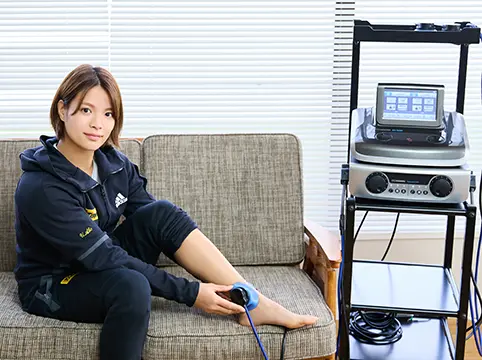
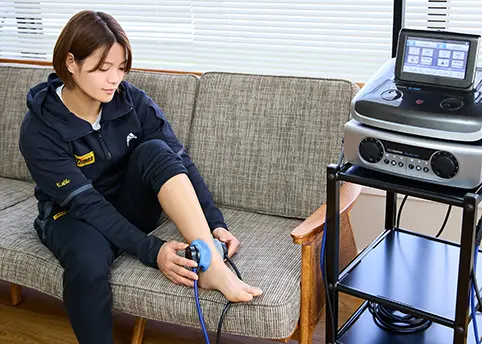
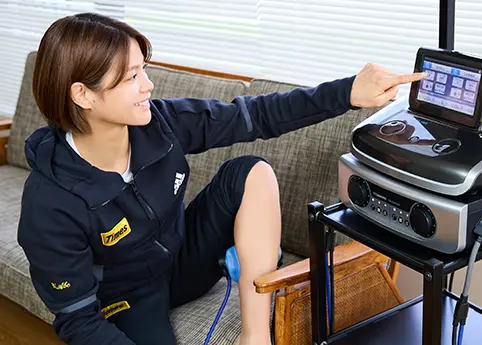
Abe: I do things like stretching and applying electrical treatment on my own, and I also receive treatment at least twice a week. As I get older, I’ve come to appreciate the importance of physical care. At night, I always apply 3D interferential current. I spend about an hour and a half at the treatment center. After a competition, care frequency tends to drop, but I also feel that it might actually be better to receive care right after a match to help my body recover.
I injured both shoulders in 2019. That experience made me more aware of the importance of care. I realized if I don’t pay proper attention to my body, I wouldn’t be able to continue as an athlete. In the run-up to the international competition in Tokyo in 2021, I remember going to rehab while continuing to practice and having my mother apply electricity as I stretched every night. If fatigue accumulates, your body tends to stop functioning properly. Daily care is important to prevent that, so I always make sure to set aside enough time for it.
You never know when and where you might get injured, which is why daily care is important
- ITO: When did you first learn about treatment devices?
-
Abe: In freshman year of high school, a senior lent me a treatment device. That’s when I learned about such devices. It was a microcurrent device, but because the current was so subtle, I could barely feel anything, and I wasn’t even sure what it was supposed to help with as I used it.
But I realized the pain would lessen when I used the device, so I thought, “Wow, this is amazing.” After entering university, I started using one at home as well, and now it’s become something I can’t do without. At training camp in my senior year, I used ultrasound and 3D interferential current. I started using these devices almost every day in the lead-up to the 2021 international competition, which I mentioned earlier. Treatment devices are also available in the PARK24 dormitory.
- ITO: In judo, what parts of the body are most prone to injury?
-
Abe: In terms of injury risk, it’s the whole body. But if I had to mention specific parts, it would be the shoulders, elbows, lower back, neck, and ankles. I’ve also injured my wrist. Since it’s a contact sport, these sorts of injuries aren’t something you can avoid simply through practice. No one knows when and how they’ll happen. That’s precisely why daily care is essential to prevent injuries, and why I need to stay in top condition at all times for practice and competition. That’s one of the challenging aspects of pursuing a career in judo.
- ITO: How did you use treatment devices before the 2025 World Judo Championships in Budapest and Tokyo Grand Slam 2025?
-
Abe: I wasn’t exactly injured going into the Budapest World Championships, but I’d hurt my sacroiliac joints, so I was constantly applying 3D interferential current to my lower back. I also had some heaviness in my shoulders. So, when applying the current, I alternated between my shoulders and my lower back.
-
For the Tokyo Grand Slam, it turned out two weeks before the competition that I’d fractured a rib. At first, I thought it was nerve pain, so I learned how to apply the current for that and kept doing that for about 40 minutes every day. But it wasn’t getting better, so I got examined. It turned out I had a fracture. I learned how to use the device to treat fracture pain. I used it from that point up to the competition for 40 minutes daily. Since I had to continue practicing, I couldn’t get rid of the pain, but as long as I didn’t hit the rib doing groundwork, I had no problem executing techniques, so I was able to compete. It’s completely healed now and doesn’t affect my performance.
- ITO: Please tell us about your daily self-care and the work you do with trainers.
-
Abe: I use a treatment device about three times a day. When I’m not injured, I sometimes cut back to twice a day, once during the day and once at night, but I always use it before bed. And I might wear a small microcurrent device during the day and sometimes I’ll leave it on while I sleep.
-
Besides self-care, I have specific people I go to for treatment, and I choose whom to go to depending on the type of care I need. For example, I ask a certain person for massages. When I had back pain that wouldn’t go away, I got a gymnastics trainer to examine me. Whatever my condition is at the time, I have people I can rely on, which is reassuring.
I want people to realize the importance of treatment devices early, before they get injured
- ITO: For athletes aiming to reach the top, in what situations do you think it would be effective to use treatment devices?
-
Abe: As was the case with me, a lot of people probably begin using treatment devices after they start feeling pain. But I recommend using them daily before pain appears, when fatigue has accumulated, or even before it accumulates. That’s because they’re effective not just for treating pain and injury, but also as support for maintaining a body that doesn’t get into such states in the first place.
For example, with junior and senior high school students, the teacher supervising them might not have much knowledge or understand the importance of care. Even if the students are feeling a bit fatigued, they might shrug it off because they’re full of energy. When you’re young, you can overdo things to a certain extent, but it’s important to get into the habit of using the devices even from those early years. Fatigue can accumulate in ways you don’t notice, which puts you at greater risk of injury.
-
That said, until you become aware of the importance of treatment devices, you won’t understand that you need them. That’s why it’s important to create opportunities for people to use them regularly, so that they can experience pain subsiding or fatigue lessening. For example, it might be good to create an incentive to use them, like giving people a reward for using a treatment device once. [laughs]
I myself didn’t use them every day until I suffered a major injury. But it’s too late once you get injured. This is what I want people to become aware of at an early stage.
- ITO: Do you have any advice for athletes, including those doing judo?
-
Abe: When you’re competing, all kinds of things happen. There will be good days and bad days, but I want you to never forget to enjoy yourself while competing. Naturally, it’s wonderful to be able to achieve your dreams and goals, but even if they don’t come true you’ll surely gain something along the way. I think it’s important to value what you’ve gained and to keep moving forward.
I want to enrich my life through judo
- ITO: Finally, please tell us about your personal goals for the future.
-
Abe: My goal is to practice hard each year, earn my place on the national team, compete in the 2028 international competition, and win. Every single year is critical, so maintaining a body resistant to injury, even as I age, is essential. I will face myself squarely and continue working while deepening my understanding of my body.
Also, ever since I was in junior high school, I’ve wanted to become an approachable athlete who is loved and supported by everyone. I have lots of people who support me, but when it comes to whether I’m living up to their expectations and worthy of their support, I’m still a work in progress. So, getting stronger and achieving results to live up to people’s expectations and repay their support is another goal.
In the future, I’d like to teach judo to young children. Lately I’ve been watching university athletes a lot, and I’m starting to think teaching at a university might also be a good option. I want to enrich my life through my involvement with judo.
![Judoka [Uta Abe]](/ito-sports-project/assets/img/interview/015/pct_bio.webp)
Born July 14, 2000 in Hyogo Prefecture. Employee of PARK24 CO., LTD. Women’s judo -52 kg category.
Influenced by her older brother, Hifumi Abe, she began judo at the age of five. In 2017, during her first year of high school, she became the youngest-ever winner of the Judo Grand Prix Düsseldorf. With her overwhelming strength, she won numerous international competitions in the following years. At the Tokyo 2020 Olympics, both she and her brother claimed gold medals, becoming the first-ever siblings to win gold medals in an individual sport on the same day.
At the Paris 2024 Olympics, she won a silver medal in the mixed team event. In 2025, she marked her return to competition after the Olympics by winning the Baku Grand Slam. She went on to win all competitions she entered: the All-Japan Judo Championships by Weight Category, the World Judo Championships Budapest, and the Tokyo Grand Slam.