
松本 直美
Naomi Matsumoto
Stepping onto a new stage to surpass the world’s best
Conditioning to raise everyday performance to a world-class level
August 3, 2026
Interview: Takaya Hirano / Photos: Maki Kato
A return to competition driven by a “now or never” mindset
- ITO: You currently play futsal, but you were a soccer player back in your school days, weren’t you?
-
Matsumoto: My older brother, who is six years older, played soccer. When I was in preschool, my mother would take me to watch his games, and I’d kick a ball around outside. The preschool had a gymnastics club and a soccer club. I was doing gymnastics but switched to soccer in my second year of preschool. After that, I joined club teams (including the JEF United Ichihara Chiba Ladies U-18) and continued playing until I graduated from high school.
- ITO: We heard that you switched to futsal after quitting soccer and becoming a chef. What prompted that decision?
-
Matsumoto: After graduating from high school, I worked as a chef at a hotel. I made a terrine for the wedding of Yuto Nagatomo, a player on the Japanese national soccer team. Since I used to play fullback myself, he was someone I looked up to. It felt like fate. A coach I knew said, “We’re short on players, so why don’t you come play with us?” That’s how I started playing futsal, just for fun. I couldn’t take Saturdays or Sundays off from work, so I didn’t have many chances to play, but I came to realize that kicking a ball is really fun. My culinary license would still be valid no matter how old I got, but I felt that if I was going to take sports seriously, it was now or never. When I talked to my parents about it, they encouraged me by saying, “Why not?” So I started taking futsal seriously.
- ITO: What do you find appealing about futsal?
-
Matsumoto: The court is small, so the transitions between offense and defense happen at breakneck speed. The energy opponents bring to trying to steal the ball is also next level compared to soccer because the players are already so close together. It’s an incredible thrill to get past an opponent. Since winning the ball can immediately create a scoring opportunity, there are lots of games where you really don’t know who’s going to win until the very last second. I often hear spectators say, “It kept me on the edge of my seat until the very end. It was really entertaining.”
-
In soccer, play resumes with a throw-in when the ball goes out of bounds. In futsal, play must resume with a kick-in within four seconds. It creates opportunities to play strategically as a team. At my club, Bardral URAYASU Las Bonitas, we have around 100 different set-piece plays. (Matsumoto transferred overseas in August.) It was hard to remember them all at first, but I think part of what makes it fun is that it requires quick decision-making. You have to assess your opponent’s position, make an instant decision, and communicate it to your teammates. Also, with arena seating, the court is really close to the stands. You can hear everything that’s said on the court, which really brings the excitement to life. I think that’s one of the great things about it.
- ITO: You started playing futsal in 2018. Since 2021, you’ve played for the Japanese national team. Do you have any specific goals?
-
Matsumoto: Last year (2025), Japan competed in the first-ever FIFA Futsal Women’s World Cup and reached the quarterfinals. I felt a deep sense of frustration at how far we still are from being the world’s best, but being able to compete on such a special stage made me eager to take to the court again at the next tournament.
Right now, I want to continue refining my skills in preparation for the World Cup, which is three years from now (2029). Unless we approach this with the mindset of surpassing the rest of the world, we won’t be able to close the gap. With the goal of raising my everyday performance to a world-class level, I decided to take on the challenge of Spain’s first division this summer. Right now there are a few Japanese players in Spain’s second division, but none in the first division. I’m looking forward to competing in the world’s top league, where national team players from powerhouse nations like Brazil and Portugal play.
How an injury during her first national team training camp changed her approach to conditioning
- ITO: How do you approach your physical training and conditioning?
-
Matsumoto: When I played soccer, I focused on building endurance. But since the futsal court is smaller and split-second movements are crucial, I’m working on improving my explosive power. As for maintaining my physical condition, since my ankles are weak, I take extra steps to care for them, including making sure the area around my ankles is loose and flexible before practice. In addition to competing, I also have a job. So even if I rush to practice right after work, I get to the venue only around 30 minutes before practice starts. That’s why it’s important to prepare efficiently, in such a short time frame. Going to practice after work means I get home late, but stretching is absolutely essential. After a bath, when my body is relaxed, I try to stretch, even if it’s just for 10 or 15 minutes.

- ITO: The domestic league runs from June through February of the following year. What’s your annual plan for maintaining physical condition?
-
Matsumoto: During the offseason, starting around April, I really focus on building strength. In May, the team holds more practices in preparation for the start of the league season. We have regular games once league matches start, so I work on getting myself in top form so I can perform well on game day. Now, rather than focusing on building strength, it’s more about fine-tuning. After the weekend game, I focus on recovery to make sure I’m as fresh as possible before Monday’s practice. From there, depending on the team’s practice schedule and how I’m feeling physically, I’ll go to the gym to work out on some days and rest on other days. I generally make an effort to get at least seven hours of sleep. When it comes to diet, I pay close attention to protein intake to maintain muscle mass. I take supplements to make up for any shortfalls.
- ITO: What prompted you to start thinking about conditioning and self-care?
-
Matsumoto: When I was selected for the Japanese national team for the first time, I suffered a muscle strain during my first training camp. I think that experience changed the way I take care of my body. It was frustrating to get injured after making the Japanese national team, which is such a special opportunity, and it made me realize I have to take responsibility for protecting my body. Since then, I’ve learned to pay attention whenever I feel a difference between the left and right sides of my body or sense that something’s even slightly off. I think strength training at the gym helps prevent injuries, but since I started doing Pilates, I’ve been able to stimulate parts of my body I don’t usually move and realign my pelvis. That’s given me a sense that my body is in good condition.
Understanding your body is key to making the most of treatment devices
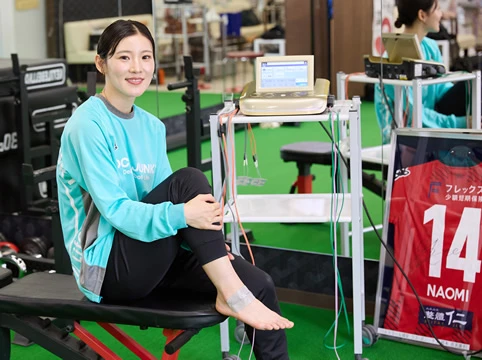
- ITO: When did you start using treatment devices?
-
Matsumoto: It was around my second year of playing futsal. When I hurt my ankle, a teammate lent me a small microcurrent device. Usually I’d just ice it, but the swelling would take a while to go down. This time, though, the swelling went down in just one day, and the pain started to subside. I thought it really worked. I borrowed the device several times after that, but I couldn’t keep borrowing it, so I ended up buying one myself. Around that time, I was getting treatment with ultrasound therapy devices now and then at treatment clinics. But at home I used a microcurrent device.
- ITO: How have you been using the devices lately?
-
Matsumoto: The team has an ultrasound therapy device and a portable low-frequency electrotherapy device, so injured players fight over them. [laughs] Even when I’m not injured, I often use the devices along with stretching to quickly loosen up my muscles a bit so I can start practice feeling limber. I often get treatment for my ankles, but even when I experience muscle fatigue in the front or back of my thighs and notice the muscles are a little tight, I use a treatment device before practice to loosen them up. I use microcurrent devices and ultrasound therapy devices even when I’m playing for the national team. And since I can walk when I’m wearing a small treatment device, I use it during long-distance travel, like on airplanes.
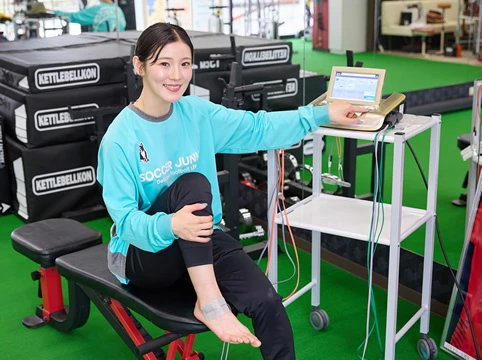
- ITO: What will you do with your treatment devices when you move to Spain?
-
Matsumoto: I’ll bring all of them with me. I’ve heard getting injured abroad can be really tough—you can’t explain what’s wrong clearly, or it takes a long time to get help. Of course, not getting injured is the most important thing, but since injuries are bound to happen sometimes, I’m really grateful I can use these treatment devices when they do.
- ITO: How do you communicate with your trainer?
-
Matsumoto: I’ll start by giving a detailed explanation of the condition of the area that’s bothering me—specifically, which parts hurt and how they hurt, as well as what movements trigger the pain. After that, the trainer explains which treatment devices to use and how to use them. As we keep communicating, I begin to understand what movements cause pain and how to move in ways that minimize the pain. I suffered a serious injury to my right anterior inferior tibiofibular ligament in February. I noticed that changing how I planted my foot affected the pain, so I realized if I adjusted how I used my body, I could reduce the pain.
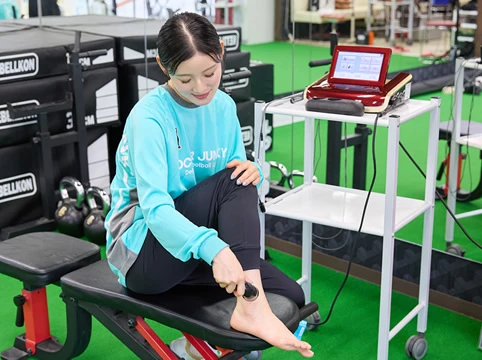
- ITO: You’ve acquired your knowledge of treatment and prevention over the course of your career. The younger and healthier the athlete is, the less opportunity they have to learn about these things until they’re actually injured. What advice about self-care would you give to athletes with ambitions to reach world-class levels in their sport?
-
Matsumoto: When it comes to treatment devices, small devices, like microcurrent devices, can be used at home while watching TV or even while you’re sleeping. Even if you can’t find the time to go to the doctor, you can manage your condition on your own. The devices may be small, but I think they’re really powerful.
-
When you go to a hospital or a treatment clinic, it’s essential to have an understanding of your physical condition and to be able to explain it clearly. So it’s a good idea to develop that skill. If you can communicate that effectively, the staff can use various treatment devices appropriately. If you lack awareness of your physical condition, you can push yourself too hard during practice or games, even when your body is sending signals that you’re in pain or at risk of injury. And that can lead to serious injuries.
The other day, on the very day a younger teammate returned to play after an injury to her medial ligament, she injured the ligament in her other leg. She was favoring her leg that hadn’t fully healed, which put too much strain on the other leg. I totally understand how, once you’re able to move again, you just want to get back out there and play. But I still think that, in the long run, it’s incredibly important for athletes to understand their physical condition and adjust how they move accordingly.
Wanting to prove that Japanese people can succeed on the world stage
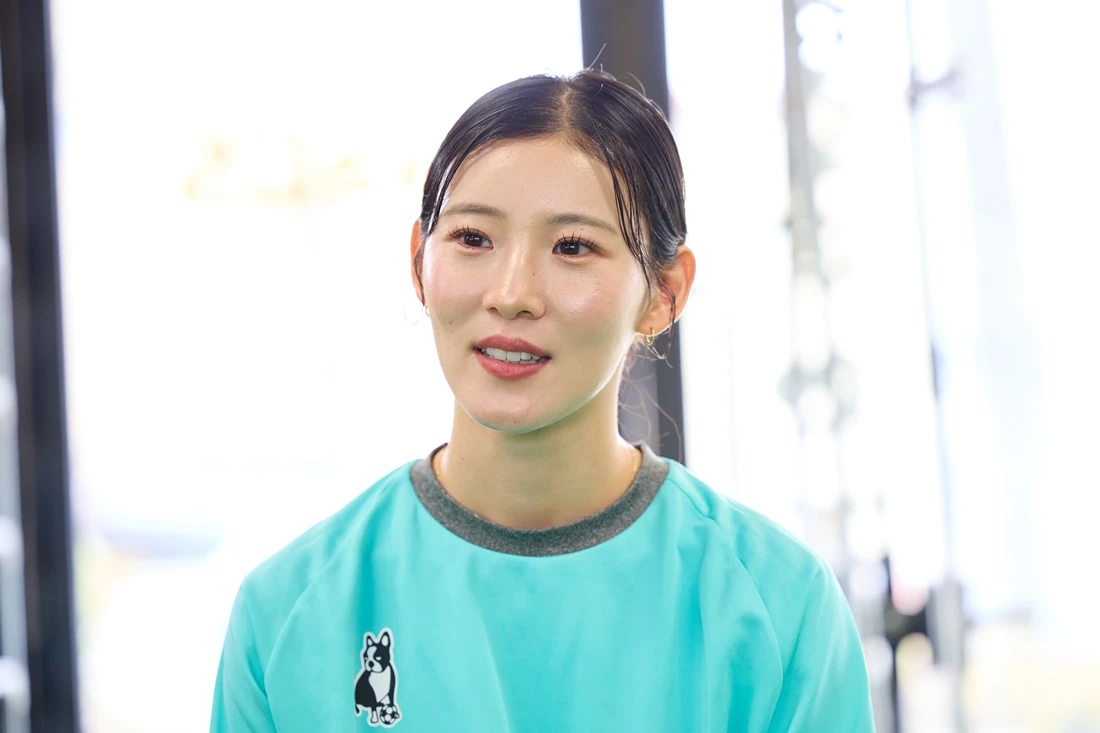
- ITO: You’re planning to take on the challenge of an overseas league and aim for your second World Cup appearance. Can you tell us once again about your goals and dreams?
-
Matsumoto: As with the World Cup, the world still sees Japan as a team that isn’t quite up to par yet and believes that we’re physically small. I want to show them that even Japanese players can compete at the highest international levels. Just appearing in games in Spain’s top division is supposed to be incredibly challenging, given the language barrier, the high level of play, and the strength of the opponents. So, first of all, I have the goal of appearing in games. That’s because Japanese players who’ve gone to Spain to compete in its top division have also struggled to get playing time.
- ITO: What kind of play do you hope to showcase on the world stage?
-
Matsumoto: My strengths are speed and aggressive defense. After winning the ball, I head toward the goal on a counterattack. Of course, I understand that the players overseas are also fast, but I want to make sure I don’t lose out to them in terms of speed. By honing my dribbling and shooting skills, I want to become a player who can score more goals. It can be hard for Japanese people to see the overseas league games live, but they’re streamed on YouTube. There’s a time difference, but I’d be happy if people watched the games online. To that end, I’ll do my best to get on the court and show everyone what I can do.

Born October 22, 1997, in Tokyo.
Inspired by her older brother, she began playing soccer at the age of five. She played for JEF United Ichihara Chiba Ladies U-18. She stepped away from competitive sports after graduating from high school but returned as a futsal player in 2018. She played for JUJO FC LADIES and SAITAMA SAICOLO before joining Bardral URAYASU Las Bonitas in 2021. She was selected to the Japanese national team for the first time in June 2021 and won the AFC Women’s Futsal Asian Cup 2025 in May 2025. She also competed in the FIFA Futsal Women’s World Cup in 2025. In 2026, she transferred to Cajasol Guadalcacín FSF in Spain’s first division. She is expected to excel on the world stage.